Tour of the City
- 1:30h
- 2.37 km
- 20 m
- 30 m
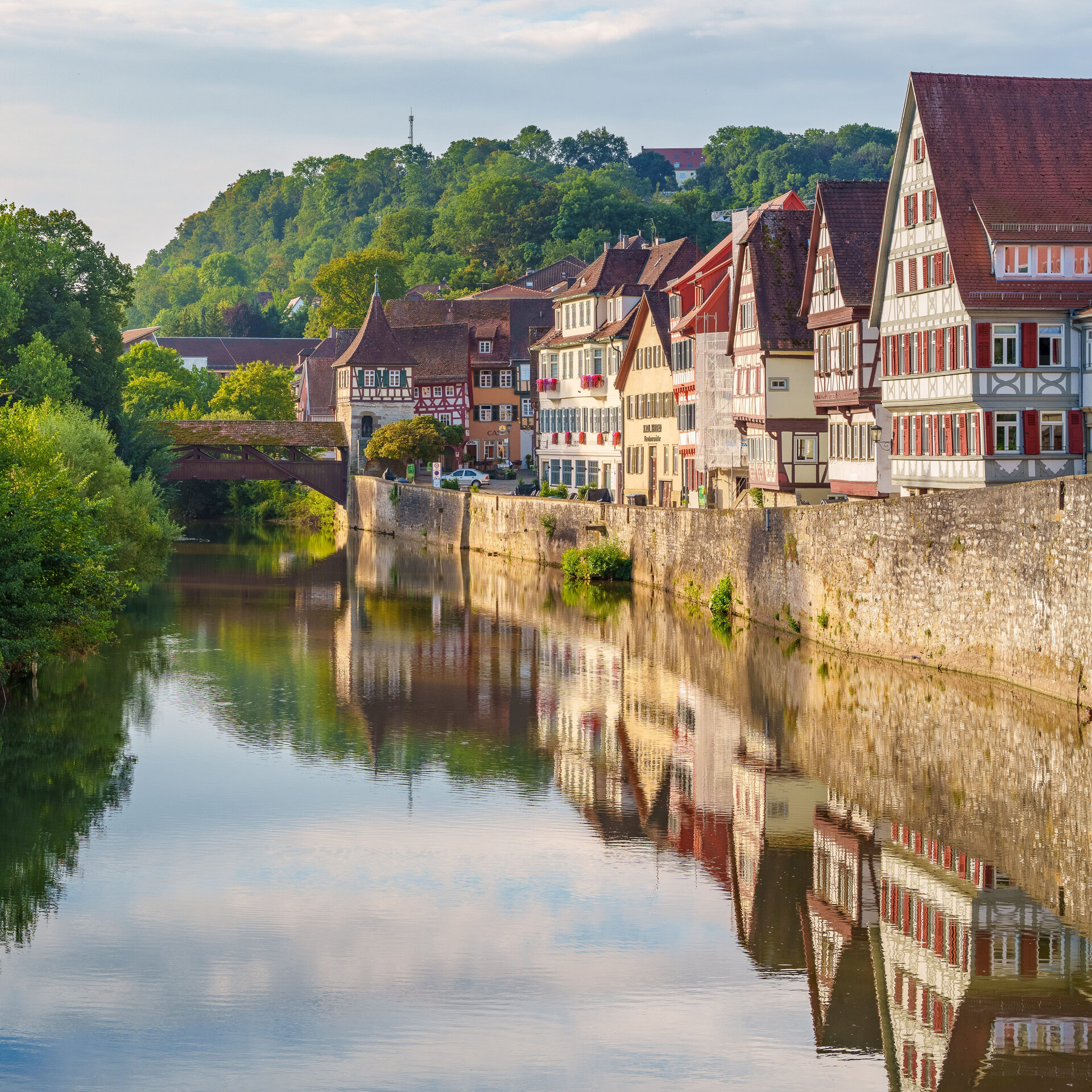
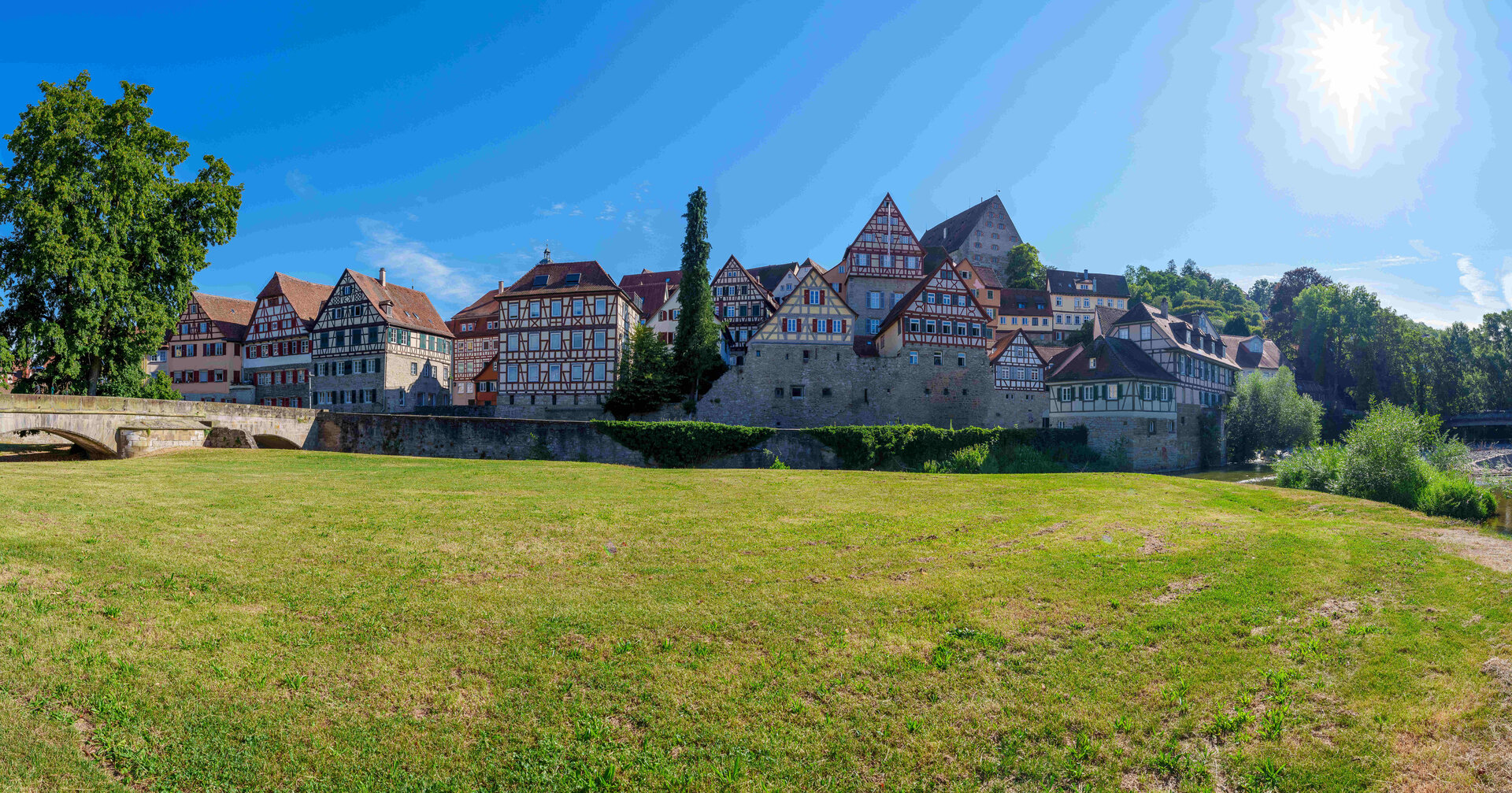
Do you want to explore the most beautiful and important sights in Schwäbisch Hall on a short walking tour? Then the city tour is just right for you. It will take you to 20 points of interest in the city center. You can take the tour with the directions and map below or you can download the digital tour here.
Details
Month
Start point
Public transit
Schwäbisch Hall also has two train stations. Schwäbisch Hall train station and Schwäbisch Hall-Hessental train station.
Directions
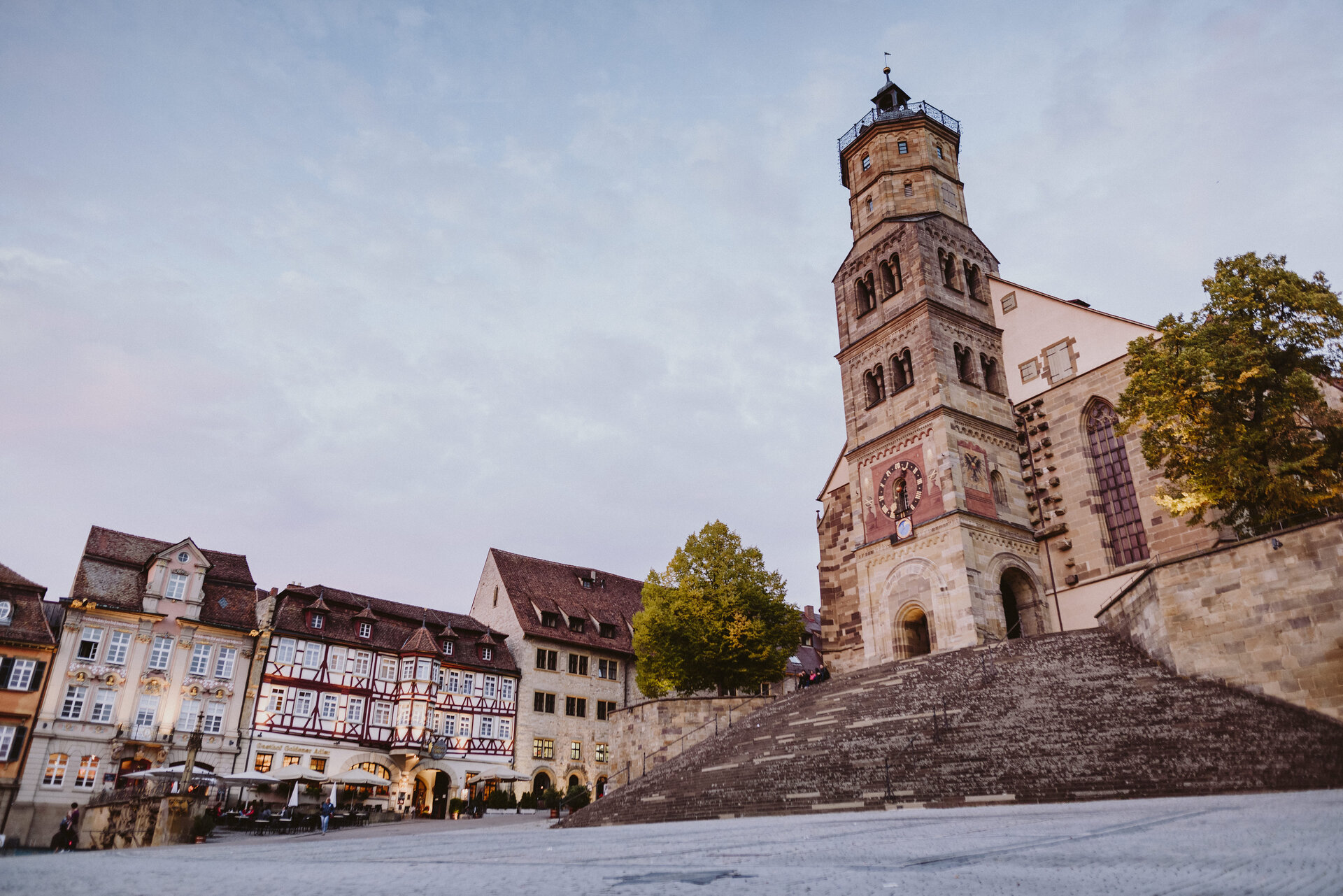
We are starting our tour on the market place. When you leave the Tourist Information and walk up the steps in front of you, you will reach one of the most beautiful market places in South Germany. There you will find yourself surrounded by all different building styles from various centuries, united in harmonious unison. Right in front of you the town hall sits enthroned.
1. CITY HALL
It was built in the style of a baroque noble palace in
the years up to 1735, after the town fire. After being
hit by a bomb and burning to the ground in 1945 it
was rebuilt at the same place in the same style and
completed in 1955. On its right there is the former
Citizens' Drinking Parlour.
2. CITIZENS' DRINKING PARLOUR
The building (Am Markt 7/8) has existed since 1510
and was rebuilt in Baroque style as well after the 1728
town fire.
3. SIBILLA EGEN HAUS
The Sibilla Egen Haus (Am Markt 9) with its magnificent
crested portal was used as a drinking parlour for the
nobility. In the previous building the rich widow Sibilla
Egen established foundations for widows in need and
for young craftsmen around 1500.
4. FOUNTAIN AND PILLORY
The Gothic style fountain used to serve as a fish depot
on market days. The three sculptures of the demon conquerors St. Michael, St. George and Samson, as well as
the Gothic style pillory, were created by the Schwäbisch
Hall sculptor Hans Beuscher. In the Early Modern Age
culprits had to atone for their minor crimes in the pillory.
The crimes were judged in public under the court linden
near the church. The timbered building beyond the
fountain has been an inn since the 16th century, today it
is the Hotel Goldener Adler. Near its roof a fire wall can
be seen, which preserved all buildings upslope from the
great town fire in 1728.
Now climb the 53 steps which take
you up to St. Michael's church.
5. THE GREAT STEPS
The Great Steps were built in 1507. Here the Freilichtspiele Schwäbisch Hall have been taking place every
year from June to August since 1925.
6. ST. MICHAEL'S CHURCH
The church was consecrated in 1156. In the 15th
century all romanesque parts of the church were torn
down, except the West tower that is still preserved
today. Starting in 1427 the nave and the late Gothic
choir with their richly ornamented reticulated vault
were erected. The building was completed 100 years
later. Outstanding works of art inside include the
Dutch Passion altar from the second half of the 15th
century and the crucifix by sculptor Michel Erhart (1494).
160 steps lead through the steeple up into the belfry
and the former tower watchman's appartment with
a superb view over the whole city. The church was
awarded the European Cultural Heritage Label.
After leaving the church through
the side door, walk round the
church building. To the right of the
church you can see the street
Pfarrgasse, next to the bookshop
Am Klosterbuckel.
7. NO. 12 PFARRGASSE
The towering building no. 12 dates back to 1460 and
was inhabited by teachers of the Latin school and by
clergymen.
If you walk straight along the street
you end up in front of the Reformer
Johannes Brenz' former home
(house no. 18).
8. JOHANNES BRENZ
The Reformer was a contemporary of Martin Luther,
and after 1522 he introduced the Reformation step
by step. Thanks to him Schwäbisch Hall was spared the
Iconoclasm so that many old works of art have been
preserved until today.
Walk up the steps on your left, then
turn right through the metal gate,
then you will get to the lookout
Schwalbennest and to the Neubau.
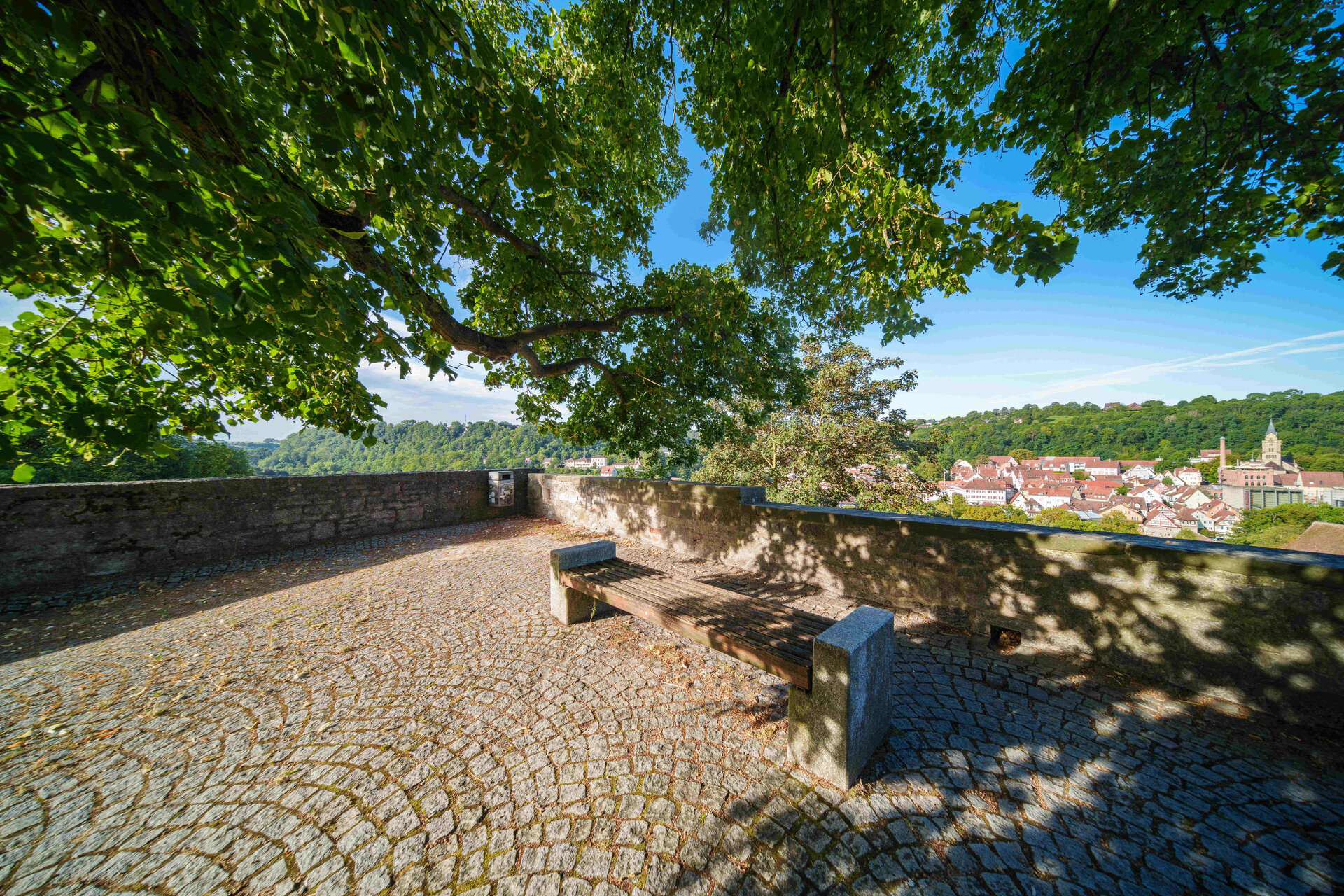
9. SCHWALBENNEST
From the observation platform you have a wonderful
view of the town. From here you can see the Katharinenvorstadt, the Kunsthalle Würth, located in between
the old half-timbered houses, St. Catherine's Church
and the striking round New Globe.
10. NEUBAU
The Neubau was built between 1504 and 1533.
The upper floors served as granaries and the ground
floor as an armoury. Today the building is used as a
concert and theatre hall as well as for conferences
and festivities.
The spiral staircase on your left
takes you down to the Schiedgraben bridge.
11. SCHIEDGRABEN
The Schiedgraben (Schied Moat) once separated the
territory of the imperial city Schwäbisch Hall from
the dominion of the Schenken von Limpurg, a noble
family. At the place where the stainless steel sculpture
by Edgar Gutbub is located there used to be the
Limpurger Tor, a city gate, which Schwäbisch Hall kept
walled up from 1431 to 1453 due to quarrels with
the Schenken. They only re-opened it after having
acquired the Schenken territory by purchase. Below
the bridge there are the Siedehütte and the HällischFränkisches Museum.
12. SIEDEHÜTTE
Inside the hut behind the Hällisch-Fränkisches Museum
the tradition of salt simmering lives on. Several times
a year there are demonstrations of how real salt is
obtained by simmering brine.
Turn right at Schiedgraben into
Obere Herrngasse.
13. OBERE HERRNGASSE
The five- to six-floor houses in Obere Herrngasse have
multi-storey cellars. The people in Schwäbisch Hall
used to live from trade and stored their goods there.
Especially large amounts of wine were stored for
resale. In 1844 the Swabian poet Eduard Mörike lived
in house no. 7 with his sister Klara. Today's Architects'
House is located opposite.
14. ARCHITECTS' HOUSE
At this place the Jewish community's prayer room
used to be located from 1893 to 1938.
15. HALF-TIMBERED HOUSE AT THE MARKET PLACE
Where Obere Herrngasse meets the market place a
mighty half-timbered building (Am Markt 2) edges the
junction. There are big round chain links on the wall.
The chain that went with it was used for cordoning off
the market place during knightly duels. These noble
judges served to carry out non-arbitrable disputes with
lances and swords.
16. SCHUHBÄCKGÄSSLE
Below Löwenapotheke you can see the alley Schuhbäckgässle. Together with St. Jacob's church (now the
location of the city hall) the buildings no. 4 (formerly
named Stellwaghaus) and no. 5 (formerly named
Widmannhaus) were the Franciscan monastery.
The name of the club Barfüßer (barefooted) in the
building's basement goes back to these Franciscans,
since the monks who lived there dispensed with shoes.
The beautiful Baroque and Renaissance style portals
on both buildings are noteworthy.
The tour now continues down
Schuhbäckgässle into Untere
Herrngasse.
17. UNTERE HERRNGASSE 2
The half-timbered house on Hafenmarkt (Olli‘s) is one
of the oldest houses in Schwäbisch Hall. Scientific
examination revealed that the wood which the houses
were built with was felled in the winter of 1288/89.
On the other side of the street the Sparkassengebäude
(savings bank building) is located.
18. SPARKASSENGEBÄUDE
When the foundation for the buildiung was built in
1939 a salt production site of the Celts was found
during diggings. The site was dated to around 500 BCE.
The wooden oriel on the building is decorated with
woodcarvings of significant city motifs: saltsimmerers
at the simmering pan, the Reformer Johannes Brenz
who lived and worked in Schwäbisch Hall in the 16th
century, as well as the Emperor Frederick I, named
Barbarossa. There is also a depiction of the minting of
Heller. In the 12th century Schwäbisch Hall became an
imperial mint. For over 200 years the Heller was used
as a coveted currency far beyond the borders of the
German Empire.
Follow the road on the left which
leads to the Hällisch-Fränkisches
Museum. Here the eight-storey
Keckenturm towers up.
19. KECKENTURM
From 1393 to 1545 the noble family Keck lived in
this Staufian tower house, which was erected around
1240. The tower is a whole 18,5 m tall and today it
belongs to the building complex of the museum.
Keep walking straight on to get to
the entrance of the city museum.
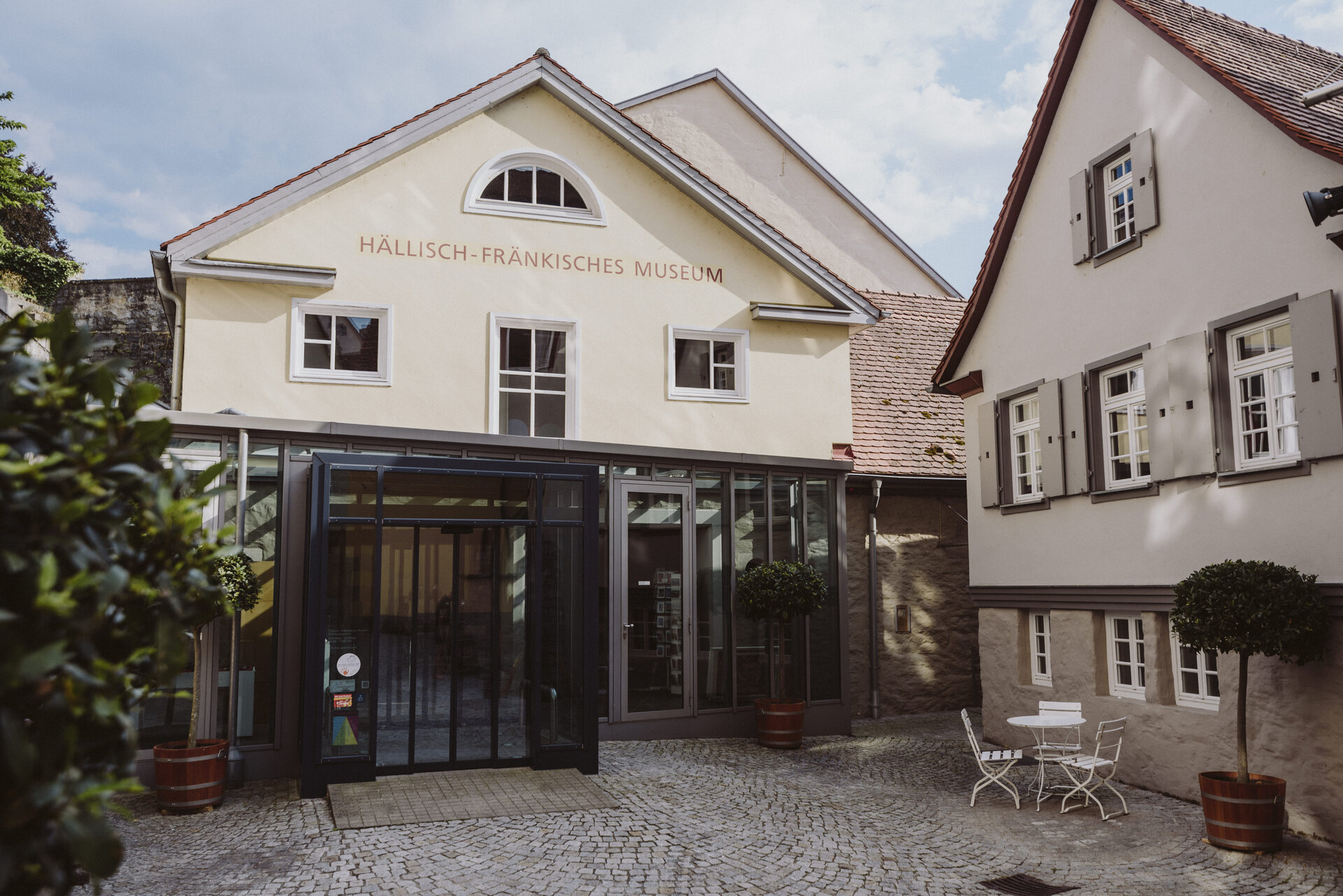
20. HÄLLISCH-FRÄNKISCHES MUSEUM
The Hällisch-Fränkisches Museum ranks among the
most beautiful city museums in the state and offers
a chronological and themed tour of the history of art
and culture of the city of Schwäbisch Hall as well as
the region Württemberg Franconia. The main focus
areas are the collection of medieval sculptures, works
of the important sculptor Leonhard Kern (1588–1662),
the culture of the Baroque and the big collection of
painted shooting match targets of the 18th and 19th
century. Free admission.
21. STADTMÜHLE
The town mill which is part of the Hällisch-Fränkisches
Museum, exhibits the local history from the French
Revolution up to the end of the 20th century. The
synagogue wainscoting from 1738/39 which is
exhibited in the section on Jewish life is a worldclass artwork. The tradition of salt production and its
importance for the city is vividly documented in the
salt and brine section. This section is closely related to
the salt simmerers' cake and fountain festival which is
held every year. Legend has it that the salt simmerers
saved the mill and the miller's family in 1316 by
helping put out a fire. To thank them the miller gave
them a 99-pound cake. This cake was decorated with
wreaths and carried to the city's fountains in a festive
procession. Even today the cake is an inherent part of
the three-day city festival.
Leave the museum and go down-
stairs on the left of the exit,
towards the river. Turn right
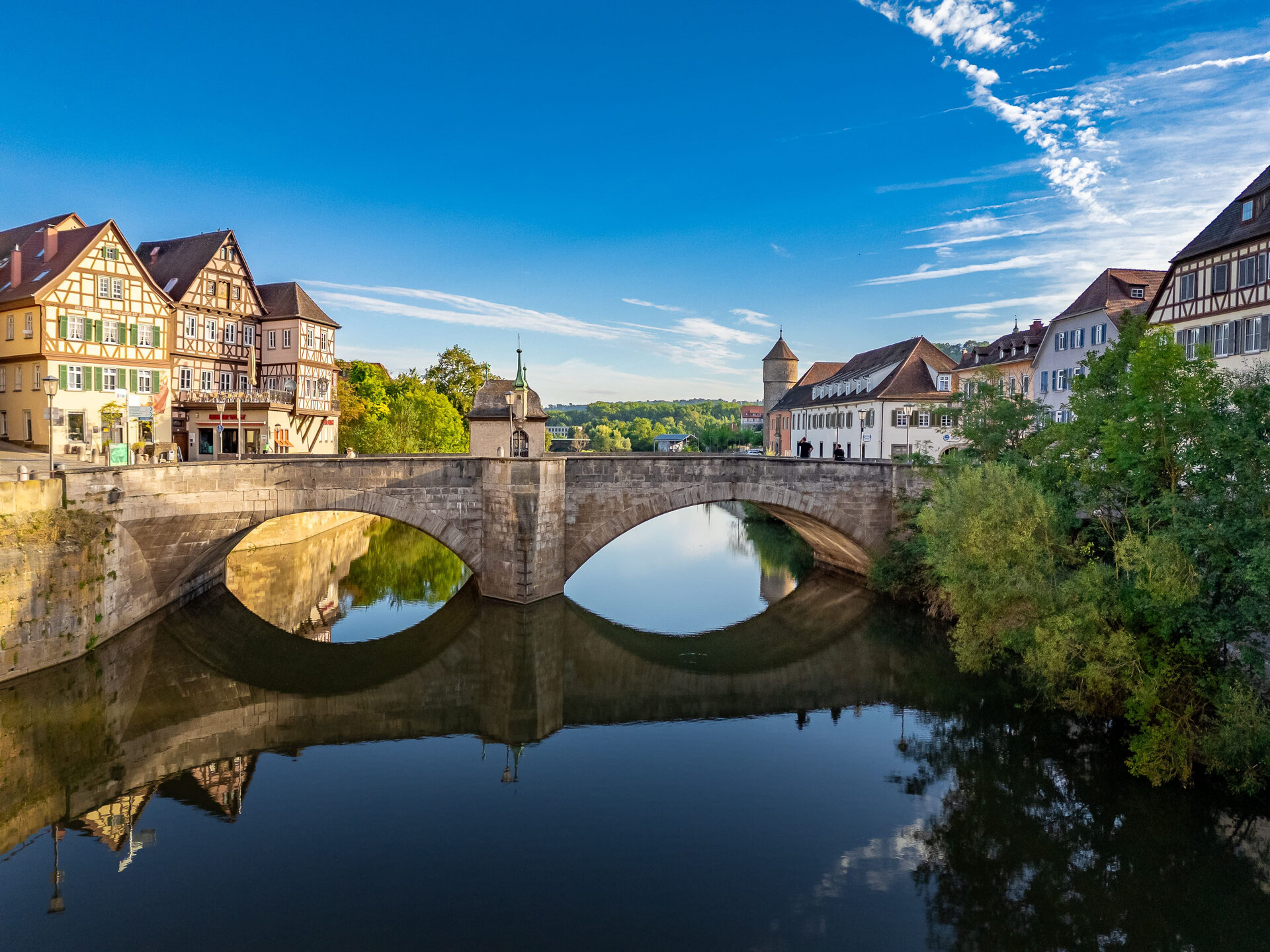
towards Steinerner Steg, then left
across the bridge and then right
again and walk across the wooden
covered bridge, which takes you
to Haalplatz.
22. HAALPLATZ
In the past Haalplatz used to be the source of all wealth
because here the brine was bucketed from the 13 m
deep well and simmered to salt. Up until the 19th
century salt was the commercial base of the city. The
city's name goes back to this tradition of producing
salt. Today the Hall brine ist still used for therapeutic
purposes.
The Haalamt is located on the left
of the wooden bridge with the
Sulferturm.
23. HAALAMT
All the salt simmerers' issues used to be dealt with
in the Haalamt (Haal Office). Today the Haal Scribe
administers the pensions which are still paid to those
entitled to inherit by the state of Baden-Wurttemberg
as the legal successor of the former Kingdom
Wurttemberg.
24. SULFERTURM
The Sulferturm was once used as a remand prison
and dates back to 1250. It was rebuilt after the great
town fire in 1728. The lower part is still the Staufian
orginal. In the Middle Ages the horses and carts
which were loaded with salt left Haalplatz via the
archway and then forded the river. The salt, the white
gold of the Middle Ages, was transported out of the
town via Steinerner Steg and Untere Herrngasse in
order to be sold on the big salt markets in Speyer,
Frankfurt or Alsace. On the way back the carts carried
mostly wine which was sold on as far as in today's
Bavaria.
Walk across the wooden bridge,
back to Steinerner Steg again and
turn right onto the Kocher island
Unterwöhrd. From there you have
a wonderful view of the historic
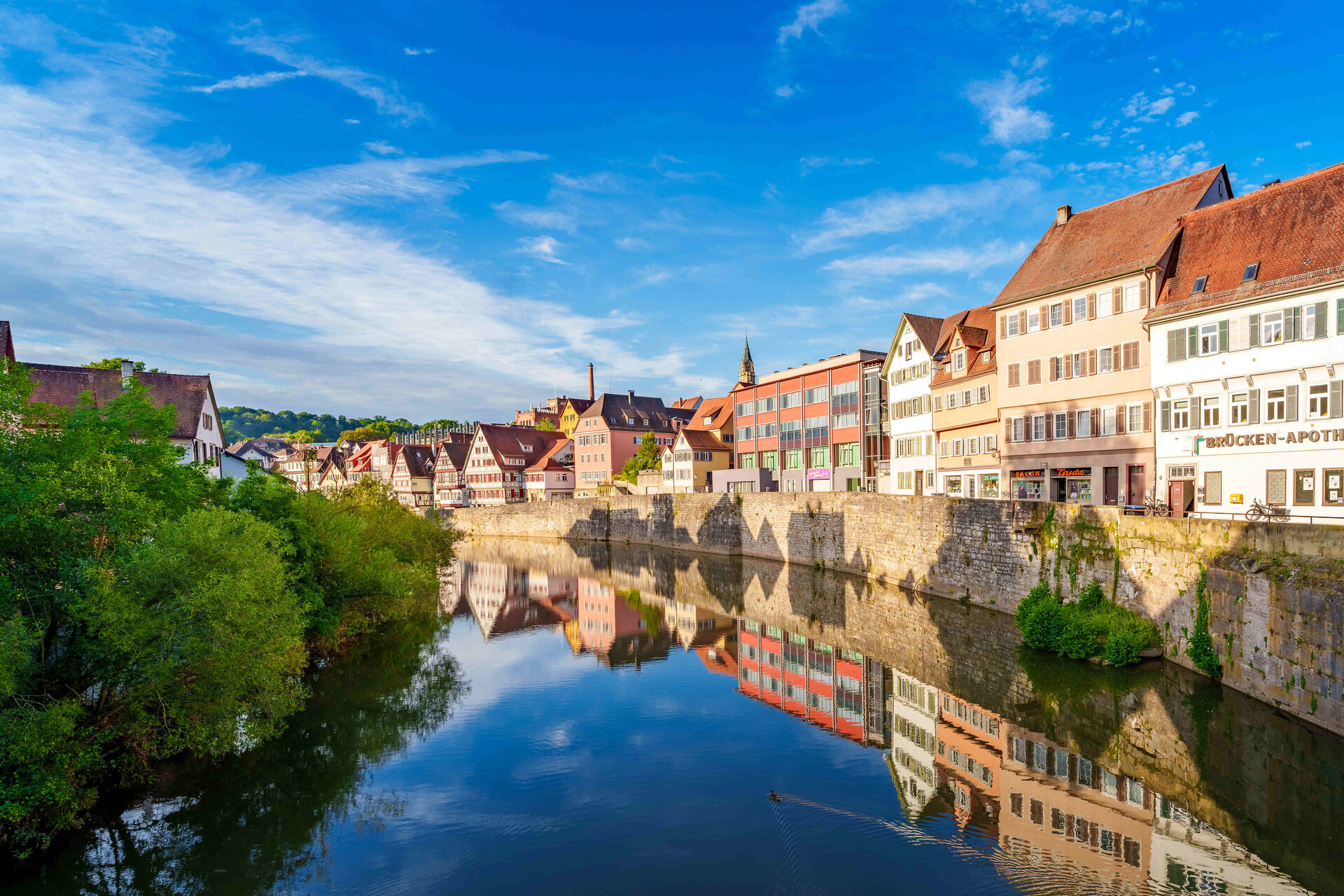
old town on the hillside.
25. THE NEW GLOBE
Plays and concerts are performed in the circular New
Globe building. The theatre with its 370 roofed seats
is a replica of the medieval Shakespeare Globe Theatre
in London.
The wooden bridge Roter Steg
takes you to Katharinenvorstadt.
26. KATHARINENVORSTADT
The quarter Katharinenvorstadt was walled in the
14th century. Small craftsmen's businesses and
manufactories settled here. Among others there were
tanners, as can be seen in the entablatures of the
furnishing shop Gräter.
Walk along Mauerstraße and just
before you get to the restaurant
Zum Löwen turn left into the
narrow Brüdergasse. Then turn
right and climb the steps to the
Kunsthalle Würth.
27. KUNSTHALLE WÜRTH
The art gallery was built in 2001 and is a spectacular
exhibition venue for international, modern and contemporary art. Presentations from the patron of art Reinhold
Würth's collection alternate with special exhibitions,
which are complemented with items on loan. From the
courtyard you have a wonderful view of the historic city.
Free admission.
From the courtyard walk past the
old brewhouse up to Lange Straße.
28. ST. CATHERINE'S CHURCH
St. Catherine's church with its valuable stained glass
and the elaborately carved high altar can be visited
at weekends. Presumably it is the oldest church in
Schwäbisch Hall.
Turn right and follow Lange Straße,
then turn right into Heimbacher
Gasse to Henkersbrücke. Next to
the department store WOHA there
is Johanniterkirche, a secularized
church dating from the 14th
century
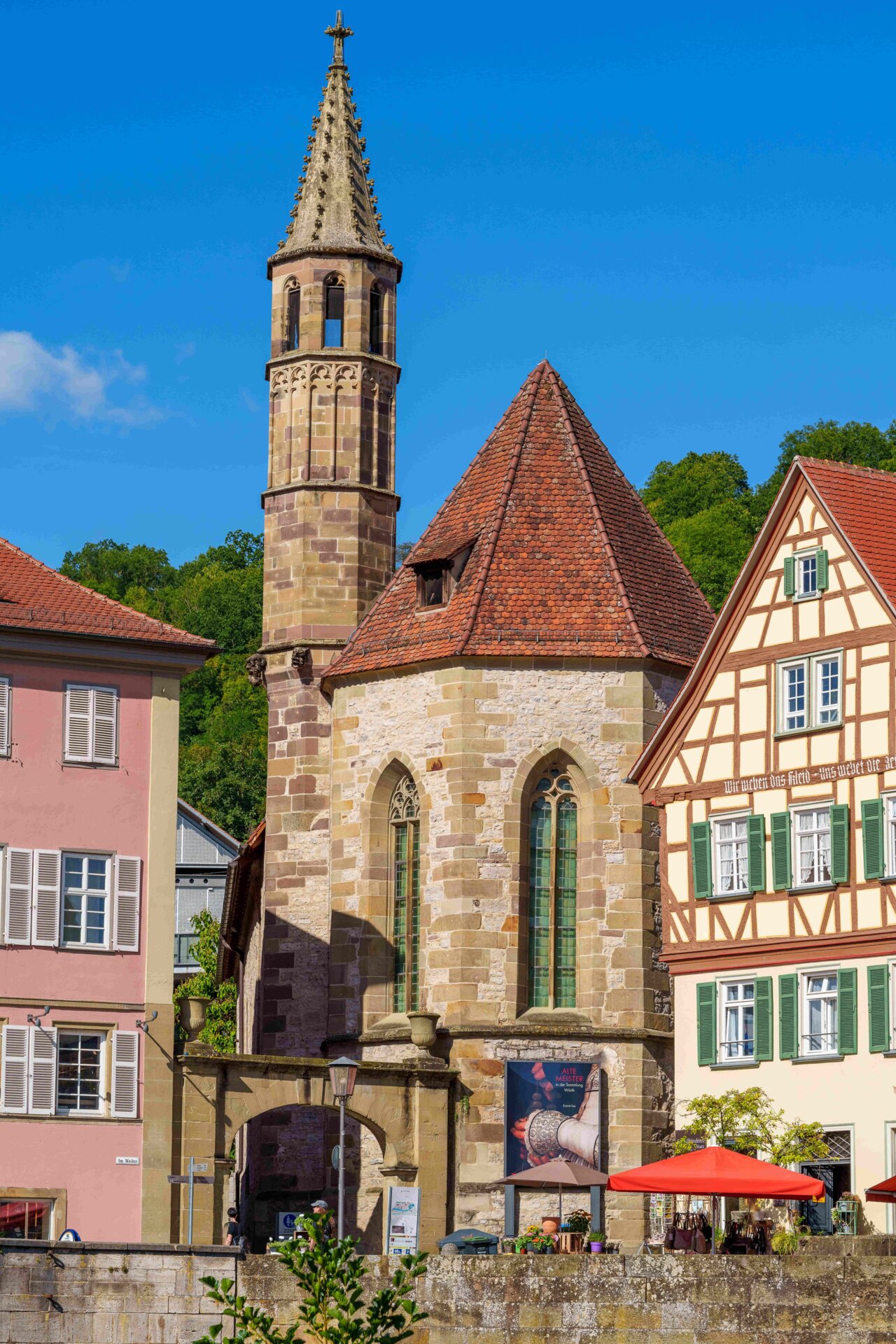
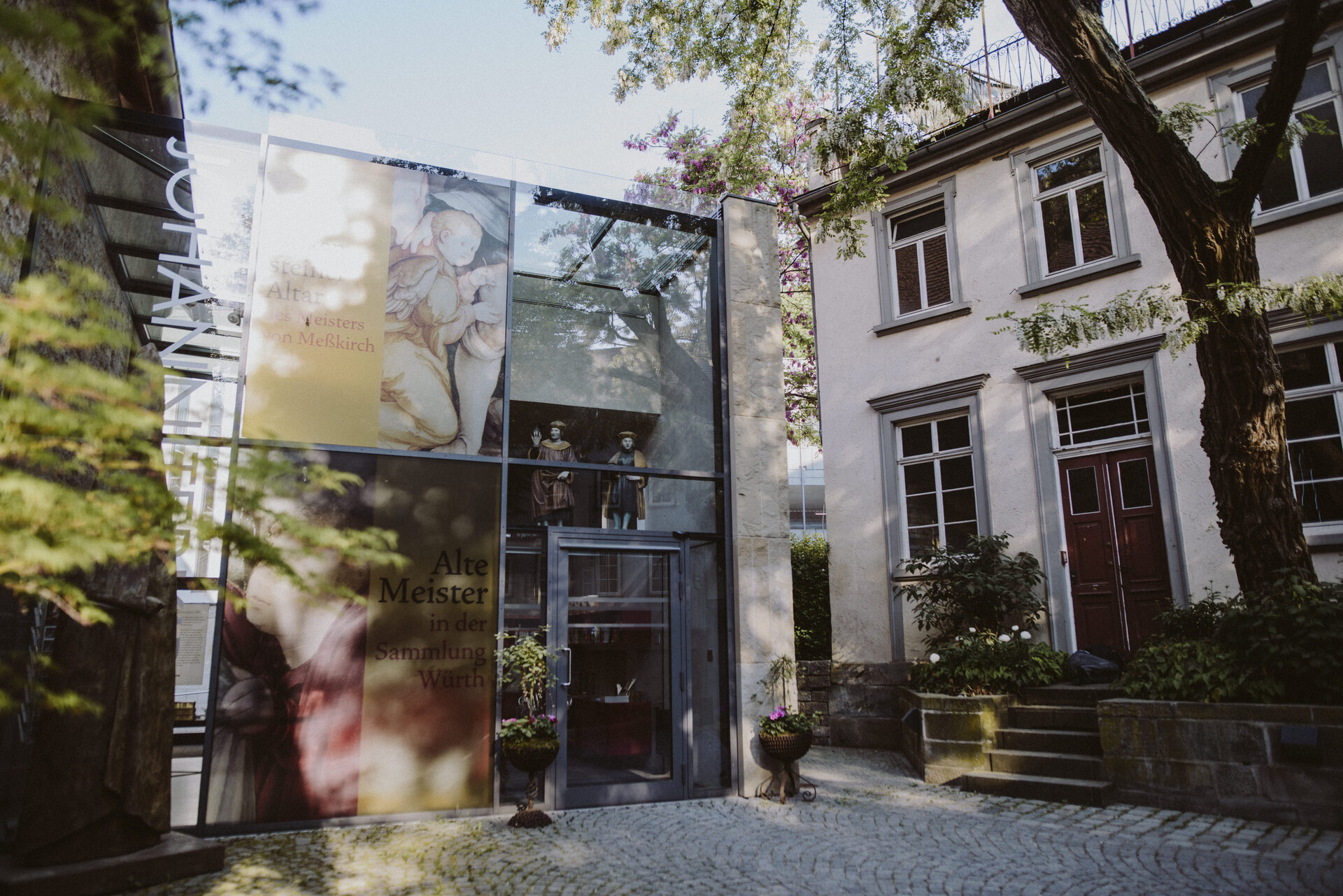
29. JOHANNITERKIRCHE
Johanniterkirche is the home of the Collection of Old
Masters, which is part of the Würth collection. In
addition to many altarpieces there are works by Lucas
Cranach or sculptures by Tilman Riemenschneider.
The famous Holbein's Virgin of Mercy is the highlight
of the collection. When the secularized 12th century
church building was extensively restored the original
Gothic roof framework from 1400-01 was uncovered.
It is the oldest of its kind in southern Germany. Free
admission.
Walk back to the bridge which
takes you back to the city centre.
30. HENKERSBRÜCKE
The stone bridge was built in 1502. On the bridge
the executioner of the imperial city collected wood as
a bridge toll. It was blown up in 1945 and rebuilt in
1949. On the left on the bridge there is the hangman's house which houses a witty vending machine.
Via the bridge you reach Neue Straße. In 1728 it was
built as an efficient fire lane from the river Kocher to
the market place. ◀ The short tour ends here.
The long tour takes you down-
stream on the Johanniterkirche
side of the river, past Café Bar Ilge
to Ringhotel Hohenlohe with the
adjacent Solebad.
31. SOLEBAD
The Solebad with its warm 29°– 36°C healing and
strenghtening Schwäbisch Hall brine is an oasis of
wellness and offers a large pool and sauna area.
100 m further on you reach
Lappeenrantasteg, another covered
wooden bridge. Cross the river
Kocher and the adjacent square,
walk past the Volksbank building
and then up Badtorweg.
From Badtorweg you have a good
view of the former prison which
today accommodates the adult
education centre and the music
school, as well as of the Kocher-
quartier shopping centre. At the
top of the lane you come across
Gelbinger Gasse and Josenturm.
32. JOSENTURM
Josenturm is one of the originally 50 towers of the city
fortifications, built around 1250 as the former chapel
St. Jodokus.
Turn left and follow Gelbinger
Gasse for 100 m until you reach a
small square. Here you can see the
district office with its wide stairway
and a sculpture in several parts by
Hans Henning Seemann.
33. GRÄTERHAUS
On the left of the square you can see the most beautiful
half-timbered house of the city. The Gräterhaus was
built in 1605 by tanner Hans Gräter.
Now turn to walk into the city. You
will pass the former Stadtpalais
Engelhardt (no. 25 on your right)
and reach Säumarkt.
34. SÄUMARKT
On your left you can see the Café Alte Wache. Its name
refers to the Wurttemberg guardhouse with its classical
portico which was built in 1811. Behind it Säumarktturm
(pre-1250, half-timbered upper part around 1600) and the
Malefizturm (pre-1200, formerly a prison) stand out. They
used to be the northern entrance to the city. Between
the two towers a part of the oldest city wall remains.
The former Hospital zum Heiligen
Geist is located on Spitalbach.
Today it houses a room for events
(Hospitalkirche) and the GoetheInstitut. The other wing is used as
a market hall.
Walk straight along Marktstraße,
back to the market place. ◀ The
long tour ends here.